
In the Footsteps of St. Louis Marie de Montfort

"Footsteps Online"
Spring 2003 (Volume 8, Issue 1)
Celebrating the 300th Anniversary of the Foundation of the Daughters of Wisdom
Fr. Paul Allerton, S.M.M.
TOWARDS the very end of 1701 or the beginning of 1702, a young woman of 17 years of age presented herself to a priest in the confessional of one of the churches in Poitiers, France, and started to make her confession. She had not got very far when the priest interrupted her to ask: "Who sent you to me?" The young woman, who had been told of this priest by her sister, replied, "It was my sister, Father." "No," said the priest, "it was the Blessed Virgin!" This was the first meeting of two extraordinary souls who together would found the religious congregation known as the Daughters of Wisdom. The priest was St. Louis Marie Grignion de Montfort, at that time just beginning his priestly ministry at the age of 28; and the young woman was Marie-Louise Trichet, known today as Blessed Marie-Louise of Jesus.
We might say that both of them, at that moment, were struggling to find their own vocation. Father de Montfort had reluctantly agreed to be chaplain of what was known as the "General Hospital" in Poitiers – though such General Hospitals were more like the equivalent of the Victorian Workhouse in 19th century Britain: a place where those too poor to have a place of their own were more or less imprisoned to prevent them being a nuisance as vagrants and beggars on the streets. Although he had a great love for the poor, and indeed identified himself very closely with them, Father de Montfort did not think that his vocation lay in "locking himself away" in such a place, but rather in going about from place to place, bringing the good news of God’s love especially to those who were most neglected in the countryside. However, he had still not found an opening for this kind of work, and was acting in obedience to his spiritual directors in taking on this job, while still waiting for a sign from God of what he was really destined to do.
Marie-Louise Trichet also had her own sense of what she was called to be: she was convinced that she wanted to be a religious, though as yet she had not found the right congregation to enter. After that first prophetic meeting with Louis Marie de Montfort, she placed herself under his direction, but it would be another 11 years or more before she could finally make public vows as a religious. In the meantime, she would have the opportunity to show the extraordinary courage, patience and humility which would enable her to be God’s instrument in the founding of the Daughters of Wisdom, and to guide the young congregation through its first difficult years.
She needed that patience, since it seemed that St. Louis Marie was prepared to help any young woman to become a religious except herself. As she kept on asking him, and even accusing him of ignoring her desires, he eventually said to her, "Very well, come and live in the hospital." She had already been helping him in the hospital since they first met, but this was a tall order: Marie-Louise was convinced that she was to be a religious, and there were no religious working in the hospital. However, after a couple of days of reflection, she applied to the Bishop to go and live in the hospital. After making enquiries, he told her there were no vacancies for any more staff there, whereupon, to the Bishop’s immense surprise, she requested permission to be admitted "as one of the poor". This really was extraordinary, as Marie-Louise was from a respectable middle-class family, with a home which was far removed from the squalor prevailing in the hospital. But the bishop must have recognised, as did St. Louis Marie, that this was an extraordinary young woman who was genuinely in search of God’s will for her, and he granted her request. And so it was that Marie-Louise Trichet began more than 10 years of living among the poorest of the poor, serving them with all the love of which she was capable.
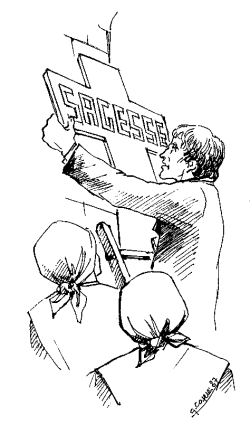 Entering the General Hospital, Marie-Louise became part of an extraordinary community which had been established there by St. Louis Marie. It was not a religious community, but a group of inmates of the hospital, who worked, prayed, reflected and ate together, supporting one another in their search for God. It was largely made up of the most handicapped and deprived of those poor people, and the leader was a blind woman. This was one of those radical experiments which we find from time to time in the history of the Church, prophetic presences in the midst of mediocrity. The group met in a room of the hospital which St. Louis Marie had called "Wisdom", and there he placed a cross on which he had painted a programme for the acquisition of wisdom. But when we look at the programme, it becomes clear that the wisdom to which he is referring is not any form of human wisdom: it speaks of "denying oneself", "carrying one’s cross", "loving the cross", "desiring crosses, contempt, abuse, insults, etc." This is certainly not worldly wisdom, which sees happiness precisely in the absence of most of these things. In fact, the wisdom which is the object of this programme is what St. Louis Marie proclaims, along with St Paul, as the only true wisdom: God’s wisdom, the wisdom of the crucified Christ. For him, as he said in his book The Love of Eternal Wisdom, "Wisdom is the Cross, and the Cross is Wisdom". Or rather, the crucified Christ is the Incarnate Wisdom of God; his most typical name for Jesus Christ is "the Eternal and Incarnate Wisdom of God". And it was the acquisition of this Wisdom, to be found especially among the poor and under-privileged, which was to be the programme and the aim of the religious congregation of which Marie-Louise was to be the co-founder with him, and the first member – the Daughters of Wisdom.
But the flowering of that religious community lay still somewhat in the future. Marie-Louise was still not a religious, and the community of Wisdom in the General Hospital was not a religious congregation. More than ten years were to go by before she would be able to make the public vows of poverty, chastity and obedience which characterise a religious congregation – years of trial, of puzzlement, perhaps of doubt, but nevertheless years of training in the divine Wisdom which was to be the hallmark of this new congregation. But a major step in its creation was taken on 3 February 1703 (exactly 300 years ago today), when St. Louis Marie gave Marie-Louise Trichet the coarse grey habit, the dress of the poor peasant women of the day, as her religious habit. And so, we date the foundation of the Daughters of Wisdom to that day, three hundred years ago.
Marie-Louise wore this grey habit of the Daughters of Wisdom for the rest of her life. She continued to wear it despite the fierce opposition of her family and the majority of the respectable middle-class families of Poitiers, who saw in it, not a "proper" religious habit, but a degrading lowering of herself to the level of the poor. The fiercest opposition came from her own mother, who tried everything in her power, including trying to enlist the support of the Bishop, to make her leave it off and return to her family. There is no doubt that this opposition caused a great deal of suffering for Marie-Louise, but she was now convinced that the path she had taken was the right one, and nothing – no amount of suffering or opposition – would turn her away from this path.
This was not the only suffering to be borne, either by herself or by St Louis Marie. Both would have to bear many trials yet before the will of God was absolutely clear to them, but they were increasingly bound together in a spiritual friendship which was based in their common search for the true Wisdom. It is evident from the letters they wrote to one another over the next few years just how deep and spiritual that friendship was. And that deep bond would be even more necessary as St. Louis Marie had to leave Poitiers, at first just for a year, but later for ever, leaving Marie-Louise to face the opposition of her family and all the "respectable" people alone. When he finally left, in early 1706, it was the start of nine years of separation, during which Marie-Louise’s constancy was to be tested, but her resolve, and her grasp of the true Wisdom, strengthened. During that time, she was joined by another, older, woman, Catherine Brunet, who became Sister Conception, and whose bubbly nature must have been a source of great comfort and strength to her over the next few years.
Finally, at the beginning of 1715, a call came from Fr. de Montfort, who was now busy working in the diocese of La Rochelle, to come to La Rochelle to take charge of free schools established by himself and the Bishop for poor girls of the city. Marie-Louise and Catherine Brunet left Poitiers and made their way to La Rochelle, and it was there, in August 1715, that they made their first public profession of vows of poverty, chastity and obedience. They were soon joined by a few other young women, and so the Congregation of the Daughters of Wisdom was finally set on a firm footing, with Sr. Marie-Louise of Jesus as its superior, and its programme of seeking and serving divine Wisdom, especially in the poor, enshrined in a new Rule specially written by St. Louis Marie and approved by the Bishop of La Rochelle. This Rule, together with the one written by St. Francis de Sales for the Visitandines and that written by St. Vincent de Paul for the Daughters of Charity, was something of a revolution in the history of religious orders of women – all three place the service of the poor and suffering over and above the rules for enclosure and cloister. A new era in religious life was born as well as a new Congregation.
St. Louis Marie de Montfort died just eight months later in the town of Saint-Laurent-sur-Sèvre in the Vendée region. Sr. Marie-Louise of Jesus was now deprived of his comforting presence and strength – but by now, she had already absorbed completely his spirit, and given it her own wise and gentle slant, and, in the years ahead, she was to be a tremendous source of encouragement for the newly-born Company of Mary, also founded by Fr. de Montfort. Under her guidance the Daughters of Wisdom grew and expanded until at her death, exactly forty-three years to the day after that of St. Louis Marie, there were 37 communities of the new congregation with 174 Sisters. But that, as they say, is another story…
